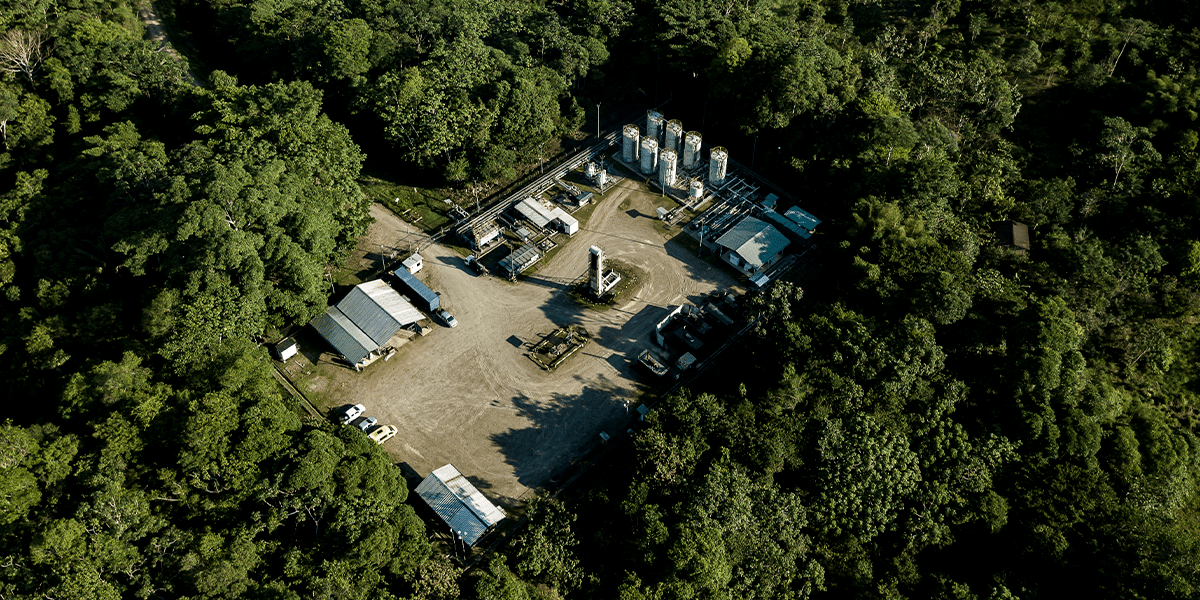
Durante años, el gas asociado —un subproducto natural del proceso de extracción de petróleo— fue considerado residuo operativo. En Ecuador, como en muchos países, la práctica habitual era quemarlo en mecheros para evitar su acumulación. Sin embargo, este método, aunque funcional, genera emisiones contaminantes, desperdicia un recurso energético valioso y se enfrenta hoy a una exigente normativa ambiental que exige su eliminación progresiva hasta el 2030.
En Gente Oil Ecuador, asumimos el desafío no solo como una obligación, sino como una oportunidad para transformar ese gas en energía útil. En el Bloque 53, estamos desarrollando un modelo técnico-operativo que convierte el gas en fuente de generación eléctrica eficiente, reduciendo significativamente las emisiones y aportando valor al proceso extractivo.
¿Qué pasa con el gas?
El gas asociado contiene un alto porcentaje de metano (CH₄) y dióxido de carbono (CO₂), superando en promedio el 72% de concentración de compuestos activos. Antes de su aprovechamiento, debe pasar por procesos complejos de desgasificación, deshidratación y adecuación para su transporte o transformación.
Los mecheros, aunque controlan la presión y eliminan excedentes, no son sostenibles ni suficientes. Incluso con sistemas de encapsulamiento o desviación, sigue habiendo riesgos de fuga y emisiones.
Por eso, en Gente Oil apostamos por una solución más ambiciosa: usar ese gas para generar electricidad en sitio.
La solución: microturbinas y motores duales
Desde junio de 2024, implementamos en Bloque B un sistema de microturbinas que transforma el gas en energía eléctrica para uso interno. Las primeras pruebas han logrado generar hasta 200 kilovatios de potencia, equivalentes a más de 5.000 kWh diarios, con eficiencia estable.
Además, estamos modificando motores diésel existentes para operar con gas dual (diésel + gas), lo cual reduce el consumo de combustible fósil tradicional y mejora la eficiencia térmica del sistema. Actualmente, cinco motores en Bloque B operan con una mezcla que ya incorpora un 20% de gas, aumentando progresivamente su capacidad.
La meta ahora es llevar el mismo modelo a Bloque A, avanzando hacia un sistema completo que utilice el 100% del gas aprovechable.
Resultados, impacto y próximos pasos
Este enfoque ha permitido:
- Reducir significativamente la quema de gas en mecheros operativos.
- Disminuir la huella de CO₂ en la atmósfera de forma medible.
- Generar energía interna que reduce la dependencia del diésel.
- Cumplir de forma anticipada con los estándares establecidos por la normativa ambiental vigente.
Actualmente, Gente Oil Ecuador es reconocida como una de las operadoras que más avances ha demostrado en el cumplimiento del plan de eliminación de mecheros hacia 2030. De hecho, nuestro compromiso interno es lograr el apagado total de mecheros para 2028, dos años antes del plazo establecido.
Desde 2014, los mecheros del Bloque 53 fueron construidos bajo normativa, y operan con estrictos controles. Hoy, son parte de una estrategia de transición energética interna, que busca convertir un pasivo ambiental en valor energético tangible.
Una transición desde el campo
La distancia entre los frentes operativos —por ejemplo, 4 kilómetros entre Bloque Norte y Bloque B— implica desafíos logísticos y técnicos. Pero cada avance es parte de una estrategia que no improvisa: diseña, mide y mejora.
La transición energética empieza aquí. No en los discursos, sino en cada válvula cerrada, cada motor convertido y cada tonelada de gas transformada en energía útil.
Gente Oil Ecuador